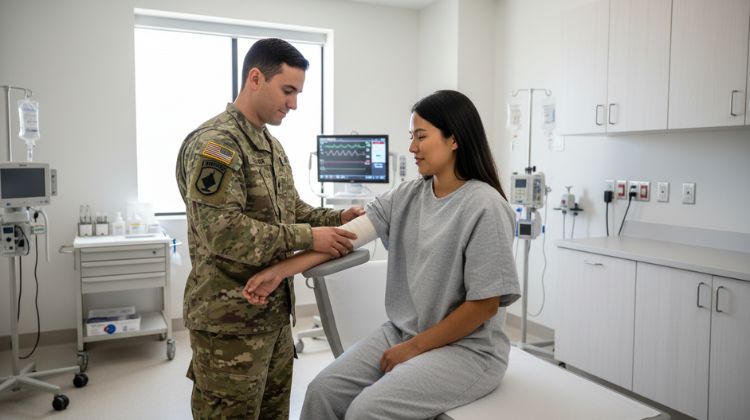
- The Army has over 140 enlisted MOS — the vast majority are non-combat support roles across medical, IT, intelligence, logistics, finance, and administration
- Enlistment bonuses reach $50,000 for 6-year contracts in high-demand MOS as of 2026 — particularly cyber, intelligence, and healthcare
- ASVAB line scores — not the overall AFQT — determine which MOS you qualify for; IT and cyber roles typically require ST: 95+ or GT: 110+
- Getting your desired MOS in writing in your enlistment contract before shipping to basic training is essential — verbal promises are not binding
- Support MOS personnel can and do deploy — “non-combat” describes your primary duty, not your risk level in all circumstances
- Many Army MOS provide civilian certifications during training (CompTIA, FAA, clinical credentials) that have direct market value on separation day
The Army is the largest branch of the U.S. military and offers the most diverse range of career options of any service — over 140 enlisted Military Occupational Specialties grouped into roughly 25 Career Management Fields. The majority of those specialties are non-combat support roles. Whether your interests are medicine, technology, law, finance, or logistics, there’s likely an Army MOS that matches.
This guide focuses specifically on the non-combat Army MOS, organized by career field, with the ASVAB line score minimums, enlistment bonus potential, and civilian career translation for each.
- How Army MOS Selection Works
- Understanding ASVAB Line Scores
- Medical MOS (CMF 68)
- Cyber and IT MOS (CMF 25)
- Intelligence MOS (CMF 35)
- Finance and HR MOS (CMF 36, 42)
- Legal MOS (CMF 27)
- Logistics and Supply MOS (CMF 92, 88)
- Signal and Communications MOS (CMF 25)
- Public Affairs MOS (CMF 46)
- Religious Affairs MOS (CMF 56)
- Enlistment Bonuses in 2026
- Tips Before You Sign
- Frequently Asked Questions
How Army MOS Selection Works
Before you ship to basic training, you and your Army recruiter will go through the MOS selection process. Your options depend on three things: your ASVAB line scores, the Army’s current needs (not every MOS is available to every recruit at every time), and any physical or security clearance requirements specific to the MOS.
TRENDING: See Today’s VA Loan Rates
You can request specific MOS codes — and in many cases you can secure a guaranteed MOS in your enlistment contract. If a recruiter tells you that you’ll get the job you want but won’t put it in writing, that’s a red flag. Verbal promises are not enforceable. Get your desired MOS written into the contract before you sign.
Army MOS codes follow a specific format: two digits identify the Career Management Field (CMF), followed by a letter identifying the specific specialty. For example, 68W means CMF 68 (Medical) plus the specific job code W (Combat Medic Specialist).
Understanding ASVAB Line Scores
The ASVAB produces multiple composite “line scores” from combinations of subtests. The Army uses ten line scores to determine MOS eligibility. The most commonly referenced are:
- GT (General Technical): AR + VE subtests. Gates most technical and professional MOSs. The higher your GT, the more options you have.
- ST (Skilled Technical): AR + GS + MC + MK. Required for medical, healthcare, and many science-related MOSs.
- EL (Electronics): AR + EI + GS + MK. Required for signal, communications, and electronics MOSs.
- CL (Clerical): AR + MK + VE. Required for finance, HR, and administrative MOSs.
- CO (Combat): AR + AS + CS + MC. Required for combat arms MOSs — less relevant for non-combat roles.
Your AFQT score (the overall percentile score) only determines whether you can enlist — it does not determine which jobs you qualify for. Line scores do that. A recruit with a 65 AFQT but high subtest scores in math and science may qualify for more technical MOSs than someone with an 80 AFQT whose subscores are spread evenly.
Medical MOS (CMF 68)
CMF 68 is one of the largest and most diverse non-combat career fields in the Army, with over 20 distinct specialties. Most 68-series jobs are based at medical treatment facilities on installation, though some specialties deploy with combat units. The exception worth noting: 68W (Combat Medic) attaches to combat units and provides care under fire — if minimal combat exposure is the goal, the clinical specialties below are better suited.
| MOS | Title | Min. ASVAB | Civilian Equivalent |
|---|---|---|---|
| 68A | Biomedical Equipment Specialist | EL: 93 | Biomedical technician ($55K–$80K) |
| 68C | Practical Nursing Specialist | ST: 95 | LPN ($48K–$65K); pathway to RN |
| 68D | Operating Room Specialist | ST: 101 | Surgical tech ($50K–$70K) |
| 68E | Dental Specialist | ST: 95 | Dental assistant/hygienist ($45K–$80K) |
| 68K | Medical Laboratory Specialist | ST: 107 | Medical laboratory tech ($55K–$75K) |
| 68P | Radiology Specialist | ST: 95 | Radiologic tech ($65K–$85K) |
| 68R | Veterinary Food Inspection Specialist | ST: 95 | Veterinary tech, food safety inspector |
| 68W | Combat Medic Specialist | GT: 107, ST: 101 | Paramedic, EMT, pre-med pathway |
| 68X | Behavioral Health Specialist | ST: 107 | Mental health tech, counseling aide |
The clinical credentials earned in CMF 68 translate directly to civilian licensing. LPN credentials, radiology certification, and operating room tech experience all carry immediate market value on separation. Many 68-series veterans use Post-9/11 GI Bill benefits to bridge into RN or physician assistant programs after service.
Interested in becoming an Army physician?
Enlisted 68-series experience is a strong foundation, but the officer path to Army medicine runs through dedicated scholarship and medical school programs. See our guide to the Army doctor program for HPSP scholarships, USUHS, and the FAP program.
Cyber and IT MOS (CMF 25)
CMF 25 covers both information technology (maintaining Army networks and systems) and cyber operations (defending those networks from attack). Cyber MOS in particular are among the most bonus-eligible non-combat specialties in the Army, with reenlistment bonuses reaching $50,000 for 6-year commitments in shortage billets.
| MOS | Title | Min. ASVAB | Notes |
|---|---|---|---|
| 25B | Information Technology Specialist | ST: 95 | Most common IT MOS; manage networks, servers, hardware |
| 25D | Cyber Network Defender | GT: 112, ST: 112 | Protect Army networks; highest civilian earning potential in CMF 25 |
| 25U | Signal Support Systems Specialist | ST: 97 | Field communications and radio systems |
| 25P | Microwave Systems Operator | EL: 104 | Long-range signal infrastructure |
| 25Q | Multichannel Transmission Systems Operator | EL: 98 | Satellite and multichannel communications |
| 25S | Satellite Communication Systems Operator | EL: 107 | Strong Space Force crossover potential |
25D is the standout in this field — cyber network defenders with TS/SCI clearances access both the highest Army reenlistment bonuses and the highest civilian salaries post-separation. The Army also funds DoD 8570/8140 certification programs (CompTIA Security+, CySA+, CISSP) during service, reducing the out-of-pocket certification costs veterans would otherwise face when transitioning.
Intelligence MOS (CMF 35)
Intelligence MOS require a security clearance — typically Secret at minimum, with many requiring Top Secret/SCI. The clearance requirement is also the primary driver of civilian earning potential; intelligence professionals with active TS/SCI clearances command significant market premiums from defense contractors and government agencies.
TRENDING: See Today’s VA Loan Rates
| MOS | Title | Min. ASVAB | Notes |
|---|---|---|---|
| 35F | Intelligence Analyst | ST: 101 | All-source intelligence; most common intel MOS |
| 35G | Geospatial Intelligence Imagery Analyst | ST: 101 | GEOINT; strong civilian GIS and contractor market |
| 35L | Counterintelligence Agent | GT: 107 | CI investigations; civilian FBI/DHS pathways |
| 35M | Human Intelligence Collector | GT: 107 | HUMINT; requires language aptitude testing |
| 35N | Signals Intelligence Analyst | ST: 112 | SIGINT; NSA contractor demand is strong |
| 35P | Cryptologic Linguist | ST: 110, language testing | Foreign Language Proficiency Pay up to $12K/year |
35P is particularly worth highlighting for recruits with foreign language ability or aptitude. Cryptologic linguists in critical languages (Arabic, Mandarin, Korean, Farsi, Russian) receive Foreign Language Proficiency Pay (FLPP) on top of base pay and are among the most in-demand veteran candidates at NSA, DIA, and defense contractors.
Finance and HR MOS (CMF 36, 42)
Finance and human resources MOS provide direct training in accounting, payroll processing, personnel management, and career counseling — skills that translate cleanly to civilian HR and finance careers.
| MOS | Title | Min. ASVAB | Notes |
|---|---|---|---|
| 36B | Financial Management Technician | CL: 101 | Army payroll, disbursing, accounting; CPA pathway |
| 42A | Human Resources Specialist | CL: 90 | Personnel actions, career management, records |
| 42R | Army Bandsperson (Musician) | Audition required | Professional-level musical ability required |
36B is the most financially lucrative of these after separation. Financial Management Technicians who pursue the CPA credential during or after service move into accounting and finance roles paying $70,000–$100,000+. The Army’s Tuition Assistance program allows active-duty soldiers to pursue accounting coursework toward CPA exam eligibility while still serving.
Legal MOS (CMF 27)
| MOS | Title | Min. ASVAB | Notes |
|---|---|---|---|
| 27D | Paralegal Specialist | GT: 107 | Legal research, document prep, courts-martial support |
27D is one of the more specialized non-combat MOS and one of the most direct pathways to a civilian paralegal career. Army paralegals work directly with JAG officers on military justice cases, administrative law, and legal assistance — gaining real courtroom and litigation support experience that civilian paralegal employers value highly. Many 27D veterans pursue the Registered Paralegal (RP) credential after separation.
Logistics and Supply MOS (CMF 92, 88)
Logistics MOS are among the most numerous in the Army. They range from supply room management and food service to petroleum distribution and property accountability. These roles keep the Army running and translate directly to civilian supply chain and transportation careers.
| MOS | Title | Min. ASVAB | Notes |
|---|---|---|---|
| 92A | Automated Logistical Specialist | CL: 90 | Inventory management using Army supply systems |
| 92F | Petroleum Supply Specialist | CL: 90 | Fuel distribution and storage operations |
| 92G | Food Service Specialist | CL: 90 | Dining facility ops; rarely deploys to forward positions |
| 92Y | Unit Supply Specialist | CL: 90 | Property accountability; direct civilian equivalent in warehouse/logistics |
| 88M | Motor Transport Operator | CO: 87 | CDL-equivalent; note: supports forward logistics convoys |
| 88N | Transportation Management Coordinator | CL: 95 | Movement control, shipping coordination |
A note on 88M: motor transport operators support forward logistics convoys, which historically carry higher risk than purely rear-area jobs. This MOS is non-combat in the sense that direct engagement isn’t the primary mission — but convoy support in deployed environments involves real risk. Recruits focused on minimizing combat exposure should discuss this with a recruiter.
Signal and Communications MOS
Beyond the cyber-focused 25B and 25D covered above, the Army’s signal corps has additional MOS focused on field communications infrastructure — installing, operating, and maintaining the networks that Army units depend on in garrison and in the field. These roles overlap with CMF 25 and are listed in the cyber/IT section above.
Public Affairs MOS (CMF 46)
| MOS | Title | Min. ASVAB | Notes |
|---|---|---|---|
| 46S | Public Affairs Specialist | GT: 107 | Journalism, media relations, digital content production |
46S produces some of the most creatively trained veterans in any MOS. Public affairs specialists write news releases, manage media relations, produce video and photo content, and often have bylines in Army publications and civilian media during service. Civilian journalism, communications, and PR careers are natural post-service transitions.
Want updates when benefit rates change?
Join thousands of service members who get our free weekly briefing.
By subscribing you agree to receive email from USMilitary.org and Military.net. Unsubscribe anytime. We don't sell your email address or give it to anyone for their marketing. Privacy Policy.
Religious Affairs MOS (CMF 56)
| MOS | Title | Min. ASVAB | Notes |
|---|---|---|---|
| 56M | Religious Affairs Specialist | GT: 100 | Support chaplains; administrative and logistical duties |
Religious Affairs Specialists support Army chaplains with administrative coordination, religious program logistics, and pastoral care support. This MOS has the lowest combat exposure of virtually any Army specialty — 56M works directly with chaplains who are non-combatants under international law.
Enlistment Bonuses in 2026
Enlistment bonuses are not available for all MOS — they target shortage specialties where the Army cannot fill seats through normal accession. As of 2026, bonuses cap at $50,000 for 6-year enlistment contracts. The highest bonus-eligible non-combat MOS typically include:
- 25D (Cyber Network Defender)
- 35P (Cryptologic Linguist) in critical languages
- 35N (Signals Intelligence Analyst)
- 68W (Combat Medic) — note the combat deployment element
- 68K (Medical Laboratory Specialist)
Bonus availability changes with Army needs and budget cycles — ask your recruiter for the current bonus schedule for any MOS you’re considering. Like your MOS, any promised bonus should be in writing in your enlistment contract before you sign.
Tips Before You Sign
Get your MOS in writing. This cannot be overstated. Your enlistment contract should specify your MOS by code. A guaranteed MOS contract means the Army is legally obligated to train you in that specialty. Open contracts (where you agree to serve without a specific MOS guarantee) give the Army flexibility to assign you based on needs at accession — which may not align with your preferences.
TRENDING: See Today’s VA Loan Rates
Know your line scores before you meet with a recruiter. Take a practice ASVAB and calculate your line scores in advance. Walking into a recruiting office knowing your approximate GT, ST, and CL scores lets you have a more productive conversation about which MOS are realistically available to you — rather than being limited to what the recruiter suggests based on their current vacancies.
Ask about the civilian credential value specifically. Some MOS produce credentials that are directly licensed by state boards — radiology, practical nursing, dental assisting. Others produce military-specific skills that require additional civilian certification after separation. Knowing which category your target MOS falls into helps you plan your post-service career from day one of enlistment.
For the full picture of non-combat military careers across all branches, see our complete guide to non-combat military jobs.
Frequently Asked Questions
The logistics and administrative MOS (92A, 42A, 92G) have some of the lowest ASVAB line score minimums — CL: 90 — and typically have the most available seats. These are also among the most stable non-combat assignments with minimal forward deployment exposure. The trade-off is that civilian salary potential is lower than technical specialties like cyber or intelligence.
In most cases, yes — but it depends on ASVAB scores, the Army’s current needs, and your physical qualifications for the MOS. Popular high-demand MOS like 25D and 35P have fewer available seats and may require higher scores or additional testing. Less competitive MOS are more consistently available. Always confirm availability and get your selection in writing before signing.
Yes. Many support MOS deploy to provide essential functions in forward areas. A 36B finance specialist may manage pay operations at a forward operating base. A 68K lab specialist may deploy to support a combat support hospital. “Non-combat” refers to the primary duty — not immunity from deployment or risk.
25D (Cyber Network Defender) has the highest ceiling for civilian earnings among enlisted non-combat MOS — TS/SCI-cleared cybersecurity professionals with military experience earn $120,000–$200,000 at defense contractors and federal agencies. 35P (Cryptologic Linguist) in critical languages is a close second for those with the language aptitude. For officer tracks, physician and JAG paths produce the highest total compensation both in and after service.
This article is provided by USMilitary.org, an independent educational resource. We are not affiliated with the Department of Defense or the U.S. Army. MOS availability, ASVAB minimums, and bonus amounts change with Army needs and policy updates — always verify current details at GoArmy.com or with an Army recruiter.
